
The **Vera C. Rubin Observatory** is a major astronomical facility under construction in northern Chile, designed to conduct the most comprehensive optical survey of the night sky ever attempted - wikipedia 
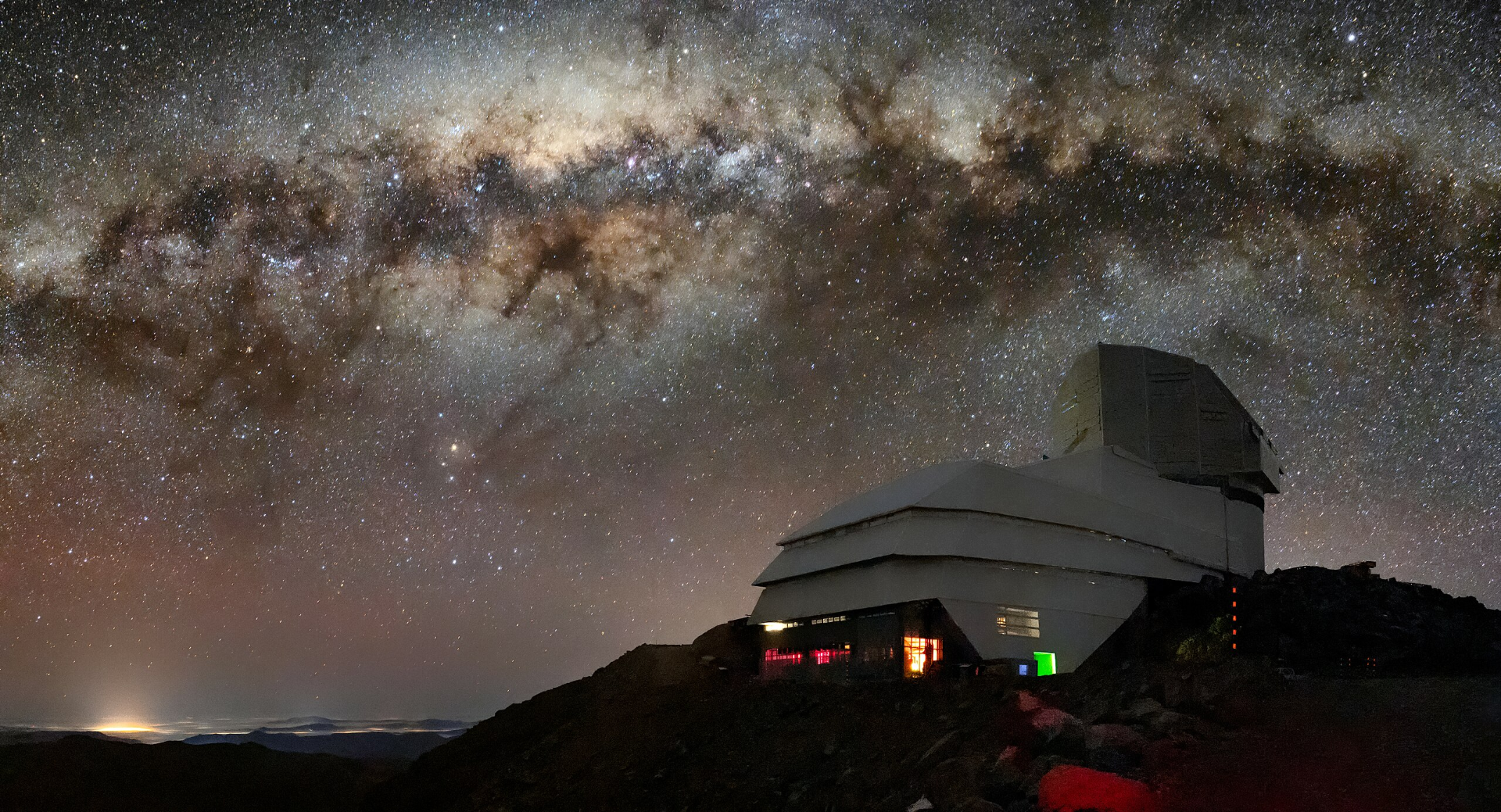
Remote image source 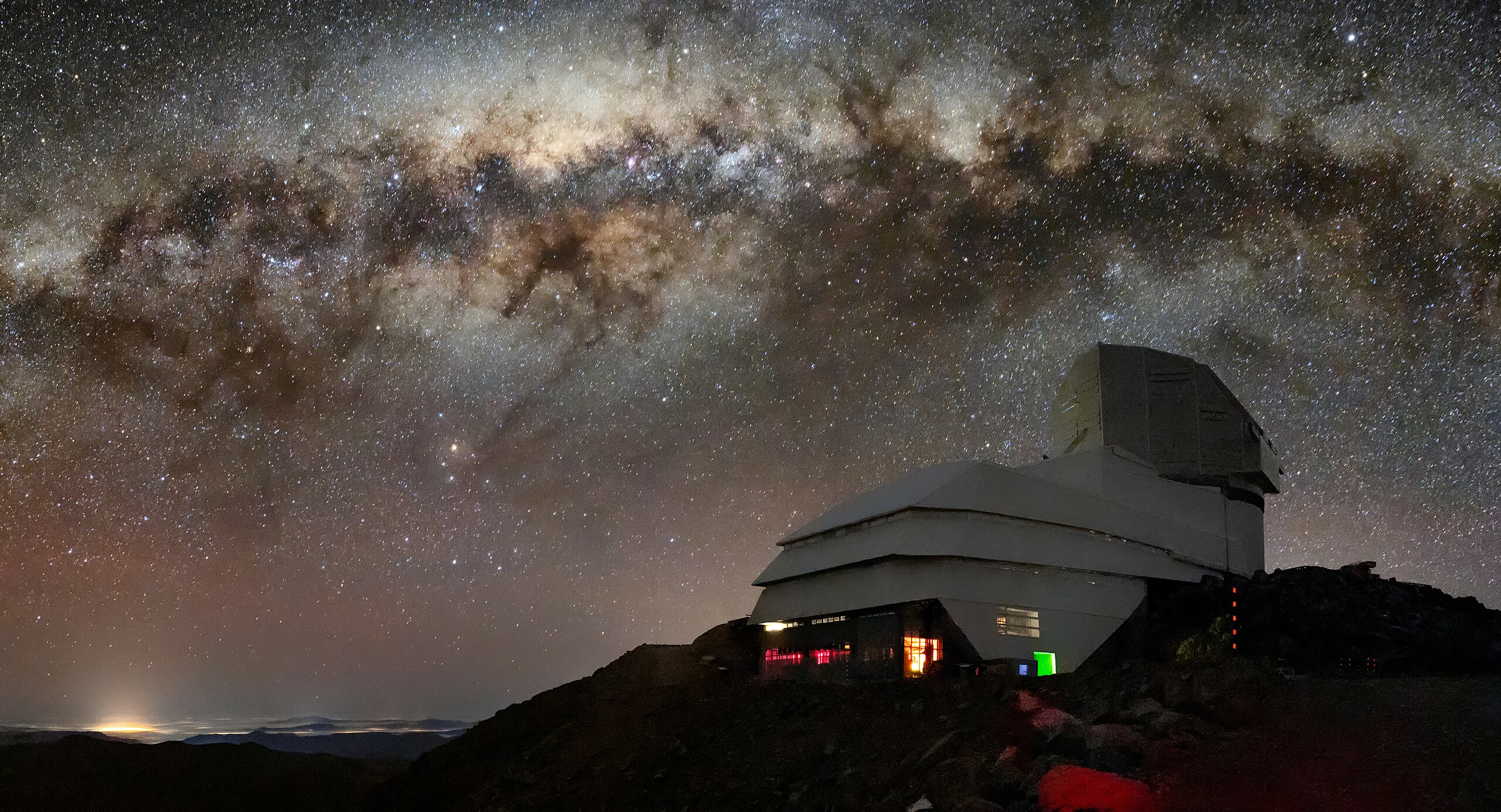
Named after pioneering astronomer Vera Rubin, whose work on galactic rotation provided early evidence for dark matter, the observatory will map billions of stars, galaxies, and transient events across the southern sky with unprecedented speed and depth.
# Location and Construction
The observatory is located on **Cerro Pachón**, a 2,682-metre peak in the Chilean Andes, near other world-class facilities such as the Gemini South and SOAR Telescope. Construction began in 2015 under the joint management of the **U.S. National Science Foundation (NSF)** and the **Department of Energy (DOE)**.
As of 2025, the Vera Rubin Observatory is nearing full operational readiness, with first light expected in **2026** following years of testing, alignment, and integration of its massive camera and telescope systems - lsst.org
# Scientific Mission The Rubin Observatory’s central mission is to carry out the **Legacy Survey of Space and Time (LSST)** — a ten-year programme that will capture a complete image of the visible sky every few nights. By repeatedly imaging the same regions over time, the LSST will create a dynamic, four-dimensional map of the universe (space plus time), enabling discoveries in cosmology, astrophysics, and planetary science.
Key scientific goals include: - Mapping the **distribution of dark matter** through gravitational lensing. - Studying the **structure and evolution of the Milky Way**. - Detecting and tracking **near-Earth asteroids** and comets. - Exploring the **nature of dark energy** via supernova surveys. - Capturing **transient events** such as gamma-ray bursts, kilonovae, and supernovae in near real-time.
This enormous data stream will provide a public database for scientists worldwide, supporting both human and AI-driven astronomical research.
# Telescope and Optical Design The Rubin Observatory houses one of the most advanced optical systems ever built: - **Primary Mirror (M1/M3):** A unique 8.4-metre mirror that combines both the primary (M1) and tertiary (M3) optical surfaces in a single monolithic glass structure, cast and polished by the University of Arizona Mirror Lab. - **Secondary Mirror (M2):** A 3.4-metre convex mirror suspended above the main mirror assembly. - **Mount:** A rapid repositioning system that allows the telescope to capture thousands of images each night.
The combined optical design delivers an exceptionally wide **field of view** — 9.6 square degrees, roughly 40 times the apparent size of the full Moon. This enables the observatory to image the entire visible sky in just a few nights - en.wikipedia.org
# The LSST Camera At the heart of the Rubin Observatory is the **LSST Camera**, the largest digital camera ever built for astronomy. - **Resolution:** 3.2 gigapixels. - **Weight:** 2.8 tonnes. - **Detector Array:** 189 individual CCD sensors arranged in a mosaic. - **Image Size:** Each exposure covers 9.6 square degrees of sky — about 40 times the area of the full Moon.
The camera captures light from the ultraviolet to near-infrared range (320–1050 nm) using six optical filters. Each 15-second exposure can detect objects 24.5 magnitudes faint — thousands of times dimmer than what can be seen with the naked eye - slac.stanford.edu
# Data Processing and the “Data Tsunami”
The LSST will generate roughly **20 terabytes of data per night**, producing a cumulative dataset of more than **60 petabytes** over its ten-year mission. To manage this flow, Rubin scientists have developed one of the most sophisticated data pipelines in astronomy, integrating high-speed data transfer from Chile to processing centres in the United States and Europe.
Advanced algorithms will automatically detect and classify transient events within 60 seconds of observation, issuing global alerts to the astronomical community. This makes the observatory a vital component of the emerging **multi-messenger astronomy** framework, where optical, gravitational wave, and radio observations are combined in real time - project.lsst.org
# Role in Discovering Planet Nine
The Rubin Observatory is expected to play a central role in the ongoing search for Planet Nine — a hypothetical large planet orbiting far beyond Neptune. Its deep, repeated sky coverage will allow astronomers to detect faint, slowly moving objects in the outer Solar System that may have eluded previous surveys.
While the James Webb Space Telescope offers detailed infrared imaging of known targets, the Rubin Observatory’s strength lies in its **broad, time-based optical survey**, capable of identifying new objects whose orbits or brightness change over years.
If Planet Nine exists, Rubin’s decade-long dataset may provide the first solid evidence by tracing subtle motions among trans-Neptunian objects and gravitational anomalies in the Kuiper Belt - scientificamerican.com
# See
- nsf.gov
- observatory.lsst.org