
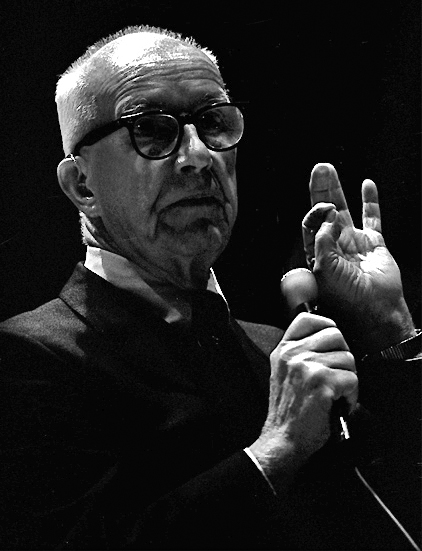
Buckminster Fuller (1895–1983) was an American architect, engineer, designer, futurist and philosopher best known for popularising the Geodesic Dome and developing the concept of Spaceship Earth. His work combined design, mathematics and humanist ideals, all aimed at making the planet sustainable through better systems thinking and technological efficiency.
Page type: history
Remote image source 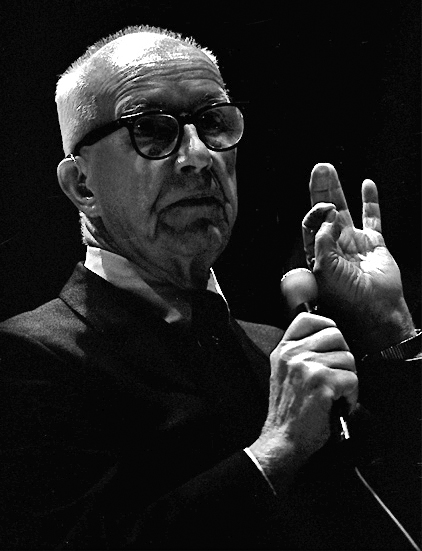
# Early Life and Education
Born in Massachusetts in 1895, Fuller briefly attended Harvard University before being expelled twice for "irresponsibility and lack of interest." - wikipedia 
His formative experiences included working in the U.S. Navy during the First World War, where he developed a fascination with logistics, mass production and systems coordination. These early influences later shaped his holistic approach to technology and ecology.
# Design Science and Invention Fuller called himself a “comprehensive anticipatory design scientist,” seeing design as a tool for solving global problems. He developed numerous prototypes — housing, transport and energy systems — guided by the principle of *doing more with less*.
His best-known physical creation was the Geodesic Dome, a lightweight, self-supporting structure made from a network of triangles distributing stress evenly across its surface. The design was used widely in military, industrial and exhibition structures and became an enduring symbol of modernist optimism - wikipedia
Other inventions included the Dymaxion Car, Dymaxion House and Dymaxion Map, each embodying his belief in efficient, sustainable, planet-wide design.
# Spaceship Earth
Fuller’s most enduring idea is Spaceship Earth, introduced in the late 1960s, especially through his 1969 book Operating Manual for Spaceship Earth - wikipedia
The metaphor portrays Earth as a shared vessel hurtling through space — finite, fragile, and without an instruction manual. Humanity, as the crew, must learn to manage limited resources intelligently, maintaining life-support systems through cooperation and scientific stewardship.
This idea reframed planetary ecology in terms of **systems design** rather than politics or economics. Fuller argued that technology should be applied not to wage war or accumulate wealth, but to ensure the sustainability of the entire biosphere. His vision anticipated modern ideas of global sustainability, circular economy, and ecological design.
# Systems Thinking and Synergetics Fuller’s theory of Synergetics — developed in his later years — described the geometric and energetic principles underlying complex natural systems. It explored how simple structural rules (such as tetrahedral geometry) could give rise to complex, stable forms in both matter and design. His work in synergetics linked art, architecture, mathematics and philosophy into a unified framework of holistic design science.
# Legacy and Influence Buckminster Fuller influenced generations of architects, designers and futurists. His ideas helped shape the environmental movement, influencing thinkers such as Stewart Brand and the creation of the Whole Earth Catalog. The Spaceship Earth metaphor remains a cornerstone of global sustainability thinking and a rallying cry for systems-based planetary stewardship. Fuller’s emphasis on self-sufficiency, modular housing, renewable energy and global resource management foreshadowed twenty-first-century concerns about climate change, population growth and the ecological limits of industrial civilisation.
# Quotations > We are all astronauts on a little spaceship called Earth - Buckminster Fuller
> Don’t fight forces, use them - Buckminster Fuller
> You never change things by fighting the existing reality. To change something, build a new model that makes the existing model obsolete. > > Buckminster Fuller
# Further Reading - *Operating Manual for Spaceship Earth* (1969) - *Synergetics: Explorations in the Geometry of Thinking* (1975) - *Critical Path* (1981)