
Janus is the Roman god of beginnings, endings, and transitions—the guardian of thresholds, doorways, gates, and time’s turnings. He is famously **two-faced**, looking simultaneously to past and future, a symbol that made him the patron of departures and returns, war and peace, and any act of crossing from one state to another - britannica.com 
Page type: science
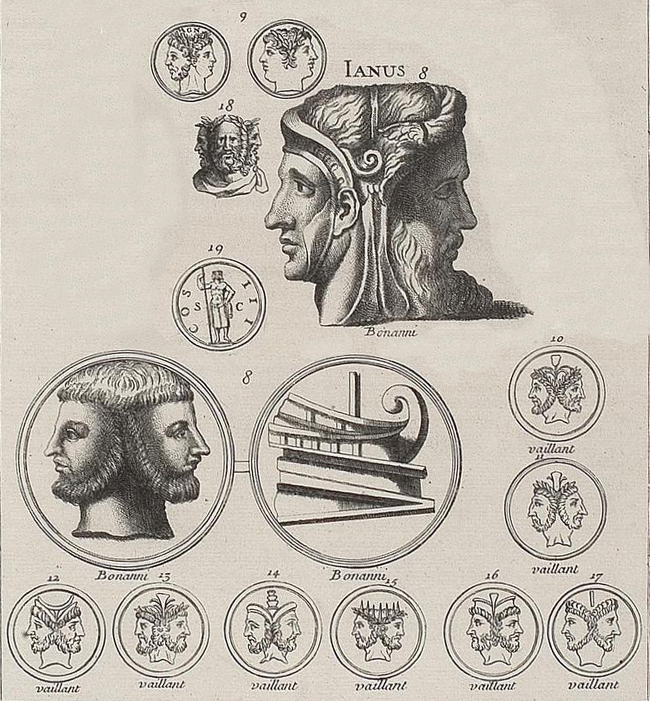
Different depictions of Janus from Bernard de Montfaucon's L'antiquité expliquée et représentée en figures - wikimedia 
# Symbols and temples
Janus is usually shown with **two faces** and often a staff and key, signifying guidance and access. In early Rome, the **Temple of Janus** in the Forum served as a civic barometer: its doors were **open in wartime** and **shut in peace**, a ritual credited to the peaceful reign of King Numa and invoked by later writers to mark rare intervals without war - britannica.com
# January and everyday words
The month **January** (*Ianuarius*) takes its name from Janus, placed at the calendar’s hinge to mark the year’s turning. The ordinary word **janitor** descends from Latin *ianitor*, “doorkeeper,” itself tied to Janus’s role as god of thresholds, showing how the deity’s domain persists in everyday language - etymonline.com - etymonline.com
# Janus in literature and myth
Roman poets cast Janus as the **first god** encountered at the outset of rites, the one you address before crossing any boundary. Ovid’s *Fasti* opens the calendar-poem with Janus explaining his two faces and his custody of all gateways and commencements, a concise ancient statement of his domain - perseus.tufts.edu
# Science and modern metaphors
In science and engineering, “**Janus**” names **two-faced** or dual-aspect systems—like **Janus particles** in materials science that present two chemically distinct sides to their environment, enabling self-assembly and directional interactions. The metaphor captures purposeful duality rather than mere contradiction, echoing the god’s watch over transitions and interfaces - nature.com
# Janus in science fiction
Science fiction adopts Janus as shorthand for **duality, portals, and liminal worlds**. In *Star Trek*, **Janus VI** is the mining planet from “The Devil in the Dark,” where a silicon-based lifeform forces a rethink of what counts as “monster,” fitting Janus’s theme of reframing the known at a threshold. Tie-in novels extend the motif—*The Janus Gate* trilogy leans explicitly into time-crossing paradox. Elsewhere, **Janus** appears in *Stargate Atlantis* as the name of an Ancient scientist whose time-loop devices literalize doorways through time - memory-alpha.fandom.com - memory-beta.fandom.com - stargate.fandom.com
# Relation to Project Janus and futures work
Modern projects borrow the name to signal **two-way sight**—backward to origins and forward to futures. In that sense, Janus is an apt emblem for scenario-building and long-range design, where the task is to hold **past context** and **future possibility** in view at once and to guide communities across consequential thresholds - futures.bmsis.org
# Why Janus matters
Janus persists as a living metaphor because every system has **interfaces**—moments where choices commit and paths diverge. Whether opening the year, closing a gate, versioning a protocol, or stepping through a speculative wormhole, we still reach first for a **guardian of thresholds**, a figure who tells us to look both ways before we cross - britannica.com