
**Project Daedalus** was a pioneering scientific study conducted between 1973 and 1978 by the British Interplanetary Society (BIS). Its goal was to design a **credible, unmanned interstellar spacecraft** using technology that could be developed within a century.
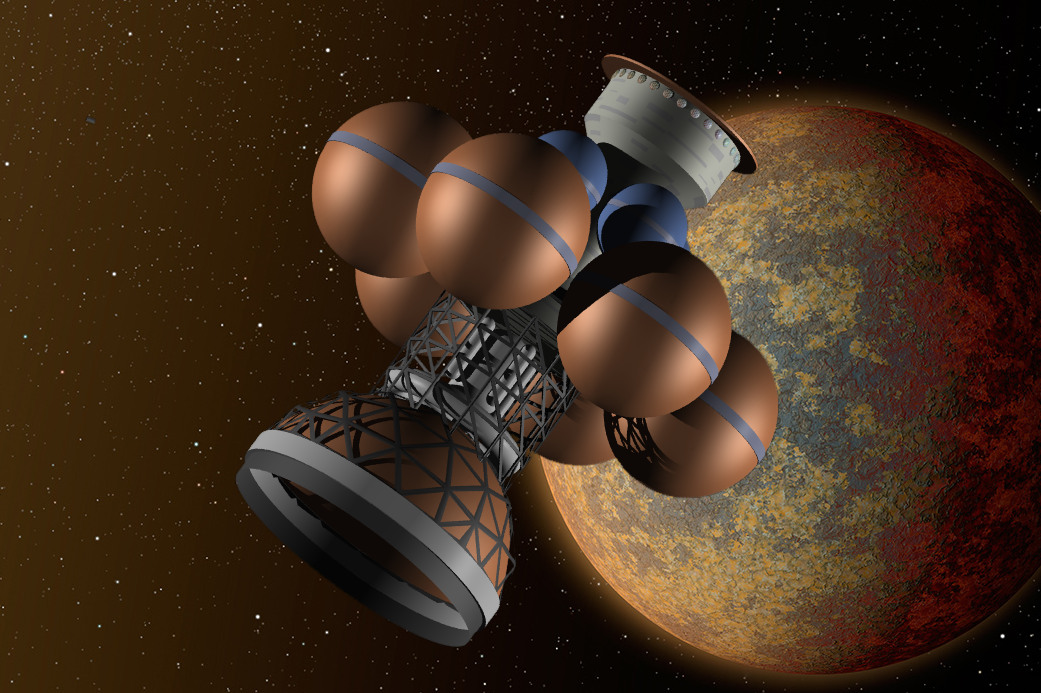
Project Daedalus spacecraft concept - wikipedia 
The study remains one of the most influential technical blueprints for interstellar propulsion, inspiring later projects such as Project Icarus and Breakthrough Starshot
# Origins and Objectives Project Daedalus emerged during the early 1970s, when optimism about nuclear fusion and space exploration was high. The BIS, led by engineer **Alan Bond** with collaborators **Anthony Martin**, **Bob Parkinson** and **Tony Redding**, aimed to answer a simple but profound question: > Could humanity reach the stars using foreseeable physics?
The team’s self-imposed constraints were strict. The design had to: 1. Use only existing or near-future technology. 2. Complete its mission within a human lifetime (less than 50 years to the nearest star). 3. Be fully robotic — no crew or generation ship. 4. Operate autonomously after launch with minimal human control.
They chose Barnard’s Star, 5.9 light-years away, as the hypothetical destination, since it was thought (incorrectly, as later discovered) to host a planetary system.
# Design Overview The resulting spacecraft design was a **two-stage fusion-powered probe**, 190 metres long and weighing approximately **54,000 tonnes** at launch. It was built around the principle of **inertial confinement fusion**, a process where small fuel pellets are rapidly compressed and heated to trigger fusion reactions.
# Propulsion System - **Fuel:** A mix of **deuterium** and **helium-3**, the latter mined from the atmosphere of Jupiter or other gas giants. - **Engine Type:** Electron-beam-driven fusion engines igniting 250 micro-explosions per second. - **Thrust:** About 7.6 million newtons. - **Acceleration:** 0.0036 g (roughly 0.036 m/s²).
The first stage would fire for two years, accelerating Daedalus to **7.1% of the speed of light (0.071 c)**. The second stage would continue for an additional 1.8 years, bringing it to a final cruise velocity of **12% of light speed (0.12 c)**. At that rate, the probe could reach Barnard’s Star in roughly **50 years**.
# Structure and Payload Daedalus would be assembled in orbit, requiring extensive space-based infrastructure. The main components included: - **Two Fusion Stages:** Each with its own reaction chamber and fuel tanks. - **Science Module:** A payload of approximately **450 tonnes**, including telescopes, sensors, autonomous factories, and self-repair systems. - **Probe Deployment:** As the craft approached its target, it would release **sub-probes** to fly past planets and transmit data. - **Communication:** A large radio antenna and high-power transmitters capable of beaming data back to Earth across light-years.
The design also included **robotic maintenance systems**, anticipating that the craft would need to survive decades without human intervention.
# Helium-3 Mining
A key challenge was the acquisition of **helium-3**, a rare isotope on Earth but present in gas giants like Jupiter. The BIS study proposed using atmospheric scoop ships to harvest and transport helium-3 to an orbital refinery before launch. This step remains one of the most speculative parts of the plan, but it also stimulated serious discussion of extraterrestrial resource mining - wikipedia
# Scientific and Engineering Legacy
Though never built, Project Daedalus remains one of the most rigorous attempts to define a plausible interstellar mission. Its methods directly influenced the fields of **fusion propulsion**, **autonomous robotics**, and **space manufacturing**. It also demonstrated that **interstellar travel is theoretically possible** within known physics — just extraordinarily difficult and expensive.
In 2009, the BIS initiated Project Icarus to update the Daedalus design using 21st-century knowledge, exploring advanced fusion methods and new targets such as Proxima Centauri.
- en.wikipedia.org
## Comparison with Later Concepts
| Feature | Project Daedalus | Project Icarus | Breakthrough Starshot |
|----------|-----------------|----------------|-----------------------|
| Propulsion | Fusion pellets (Deuterium–He³) | Updated fusion or antimatter-fusion | Laser-driven lightsails |
| Payload | 450-tonne science module | Flexible, modular payloads | Gram-scale microprobes |
| Target | Barnard’s Star | Proxima Centauri | Alpha Centauri |
| Travel Time | 50 years | ~100 years | 20 years (at 0.2c) |
| Crew | None | None | None |
(Values approximate; see individual studies for detailed designs.)
- en.wikipedia.org
## Criticisms and Feasibility
The most significant issues remain:
- **Fuel sourcing:** Helium-3 mining at Jupiter-scale quantities is beyond current capability.
- **Fusion control:** Inertial confinement fusion has yet to be demonstrated for continuous thrust.
- **Scale:** Building a 50,000-tonne spacecraft in orbit would require extensive industrial infrastructure.
Despite these challenges, Project Daedalus provided a **proof of principle** — showing that interstellar flight is not forbidden by the laws of physics, only by the limits of engineering and economics.
## Cultural Influence
Daedalus inspired a generation of engineers, scientists, and science fiction authors. Its ideas appear in works by Arthur C. Clarke, Gregory Benford, and Stephen Baxter, who all referenced fusion-powered starships and interstellar probes modelled on the Daedalus concept. The design remains a benchmark for hard science fiction depictions of interstellar travel.
## Legacy and Future Studies
Today, Project Daedalus serves as a historical foundation for interstellar propulsion research. It laid the groundwork for:
- **Project Icarus** (2009–present): BIS and Icarus Interstellar.
- **Project Longshot** (NASA/US Naval Academy, 1988).
- **Breakthrough Starshot** (2016–present).
These projects continue to refine Daedalus’ legacy with new propulsion methods, materials, and mission architectures.
Project Daedalus stands as the first serious attempt to answer a timeless question:
*If we cannot go faster than light, how far can we still go?*
# See