
A rectenna (rectifying antenna) is a receiving structure that converts an incoming radio or microwave beam directly into direct current (DC). Each element is half antenna, half power electronics: metal traces capture the field, a high-speed diode rectifies it, and filters smooth the output for delivery to a load.
Page type: science
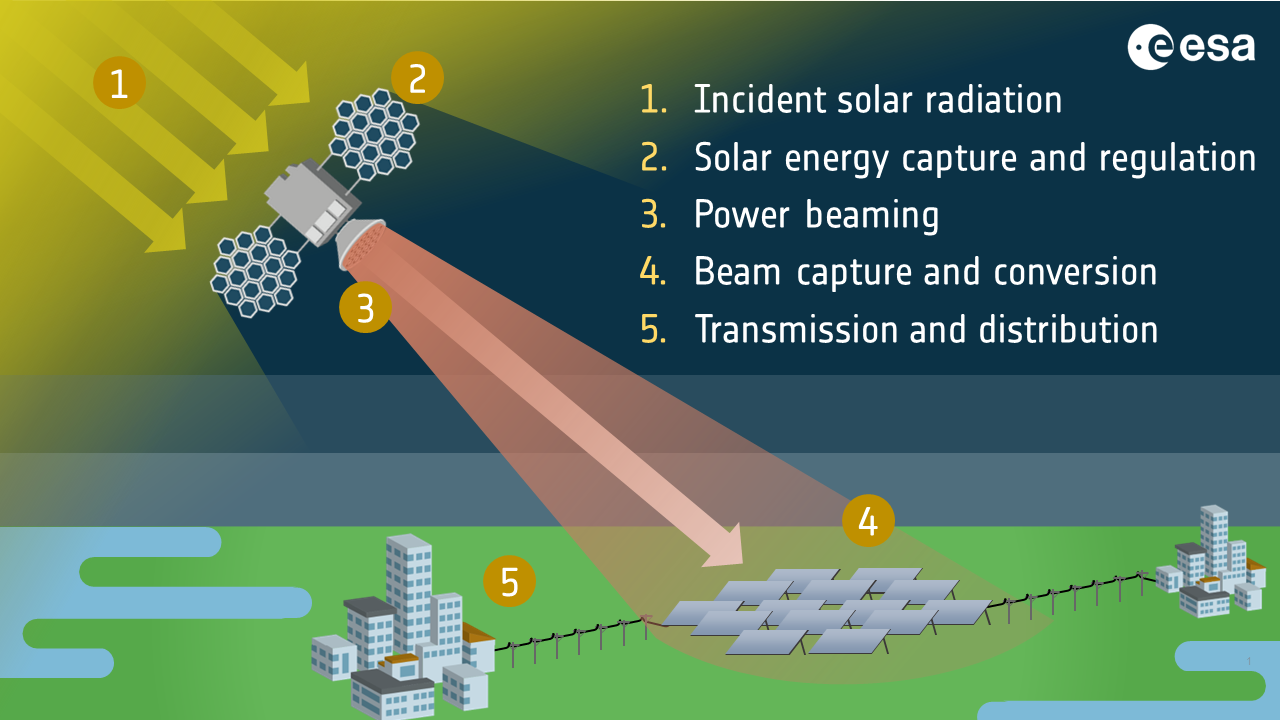
Space-based solar power (SBSP) could be an efficient source of clean and reliable energy on Earth or other surfaces such as the Moon - wikimedia 
Rectennas are the ground receivers for Space Solar with microwave beaming, and they also appear at smaller scales in RF energy harvesting and sensing - cambridge.org 
# How it works
At the element level, a resonant antenna (often a dipole or patch) is impedance-matched to a rectifier, typically a Schottky diode for its low forward drop and fast switching. A low-pass filter follows the diode to extract the DC component while rejecting harmonics. Thousands to millions of these “rectifying pixels” are combined into panels and then fields, with power combined and conditioned at the edge of the array - jstage.jst.go.jp
YOUTUBE w5SBF48WqV4
How Does Wireless Power Transfer Work - caltech.edu
YOUTUBE c2mgpMy-_mU
Space Solar Power Demonstrator - caltech.edu
# From panels to fields
Utility-scale receivers for beamed power are **sparse meshes** elevated on poles. The mesh spacing is sized to the beam’s wavelength (centimetres for ~2–10 GHz), so sunlight, rain and wind mostly pass through. Historic and modern demonstrations show how subarrays are tiled into hectare- to square-kilometre-scale rectennas feeding grid-connected substations - ntrs.nasa.gov
# Safety and exposure
Rectennas operate at **low power density spread over large areas**, with beam control that keeps on-site levels within public RF exposure guidelines. Designs use phased arrays and retrodirective tracking to keep the main lobe centred and edges tapered, so perimeter levels fall below reference limits used by regulators - icnirp.org
# Efficiency and performance
End-to-end performance multiplies several terms: antenna capture, diode rectification, RF/DC combining, and grid conversion. Lab and field work have reported **high rectification efficiencies** at microwave frequencies; in NASA/JPL’s 1975–1980 Goldstone tests, the 24.5 m² rectenna converted **> 82%** of the microwave power striking it into DC, delivering > 30 kW across the array—an early proof that large rectennas can be highly efficient - ntrs.nasa.gov
# Variants and frontiers
Beyond classic 2.45 GHz and 5.8 GHz systems, researchers are pushing **millimetre-wave** and **metamaterial** rectennas for compactness and beam agility, and **optical/infrared “rectennas”** that aim to rectify much higher-frequency fields. These frontier devices trade raw efficiency for size and integration benefits and are active areas of materials and device research - ncbi.nlm.nih.gov - theiet.org - techbriefs.com
# Rectennas in space solar demos
Modern space-solar prototypes include on-board **test rectennas** to verify beam-forming and control. Caltech’s MAPLE experiment (2023) demonstrated wireless power transfer in space and used internal rectenna boards to measure beam patterns before planned down-link experiments to Earth receivers - caltech.edu - its.caltech.edu
# Land-light footprint
Because a rectenna is a **wire lattice on stilts**, land beneath remains usable for agriculture, grazing and habitat. Compared with dense, opaque ground-mounted PV, a rectenna’s default geometry is “agri-first,” with the energy conversion literally woven through open airspace. Siting studies since the original DOE/NASA work have explored how to place these large but permeable receivers near load centres or offshore while meeting environmental constraints - ntrs.nasa.gov
# A short history
The rectenna was championed by **William C. Brown**, whose beamed-power helicopter flights in the 1960s and later Goldstone field tests established the architecture still used today. Contemporary national programmes (e.g., Japan) continue ground campaigns that pair phased-array transmitters with rectenna panels to validate pointing accuracy and conversion at useful scales - warwick.ac.uk - jstage.jst.go.jp
# Videos to accompany the article
YOUTUBE JLVx56c9_30
- **Lecture: Recent advances in beam wireless power transfer for SPS in Japan** (2021) - youtube.com
# Sources
Accessible technical overviews and reviews of rectenna design, efficiency and arrays - jstage.jst.go.jp - spectrum.ieee.org - ncbi.nlm.nih.gov