
Space Solar is the idea of collecting sunlight in orbit, converting it into a beam, and delivering that energy to Earth where it is turned back into electricity for homes, industry, and transport.
Page type: science
Because space has uninterrupted, high-quality sunlight and no weather or night, a power station in orbit can generate almost continuously and send energy to rectennas—large, open lattices of wire and diodes on the ground that quietly turn the beam into grid power.
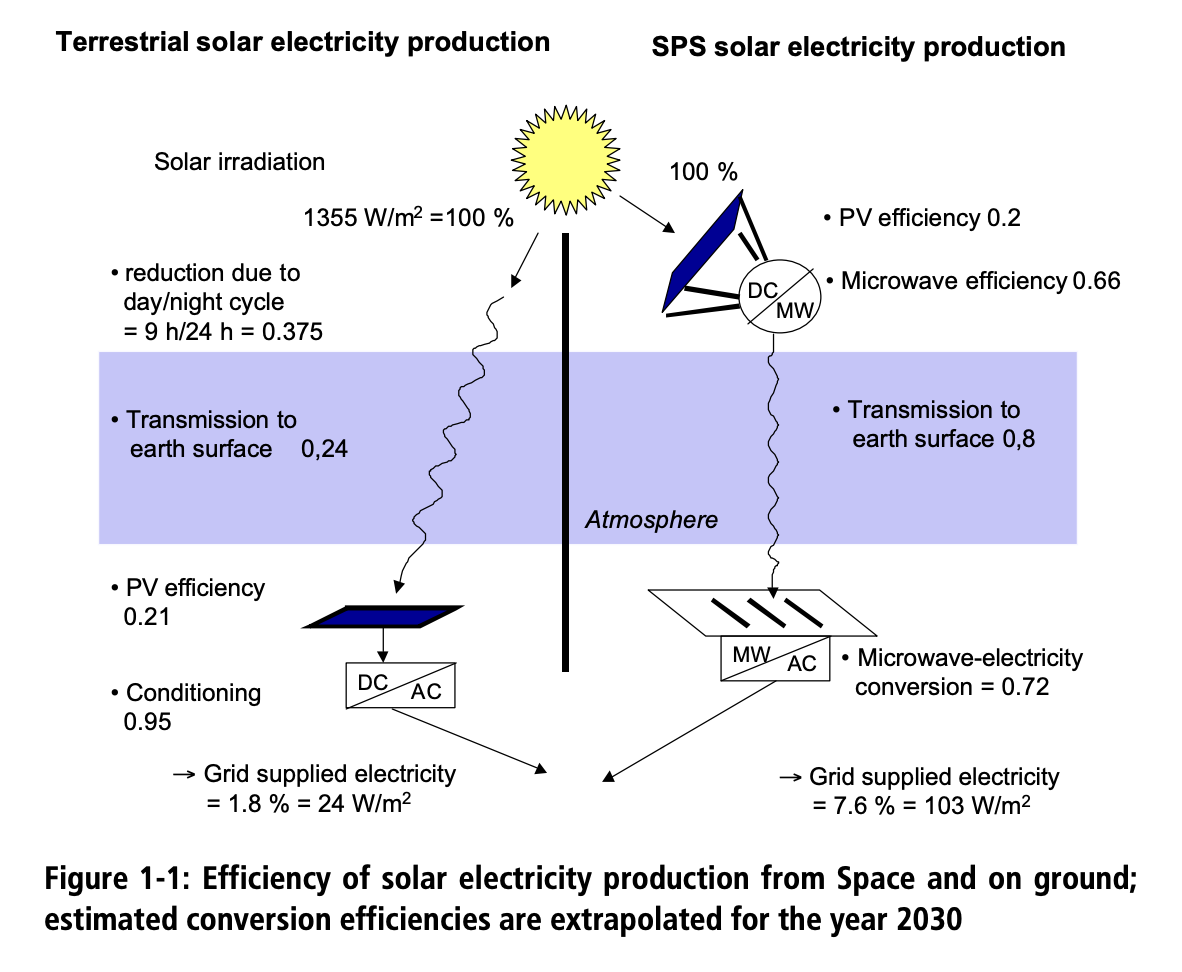
Efficiency of space solar.
# What it is
Instead of building ever-larger solar farms on land and then storing their daytime output for nights and winters, Space Solar shifts the collector into space. A satellite (often imagined as a modular “power island”) spreads out ultra-light photovoltaic sheets, turns sunlight into electrical power, and then forms a precisely steered beam aimed at a designated site.
On the ground, the beam lands on a rectenna field; the field’s electronics convert the incoming energy to direct current, which in turn feeds the local grid. The beam can be paused or redirected, making Space Solar dispatchable in a way that complements wind, terrestrial solar, hydro, and storage.
# The main technologies
At the heart of the system are three families of technology that have each been demonstrated in parts, and are now being knitted together.
Lightweight power generation and structures: satellites use thin-film, radiation-tolerant photovoltaics arranged in modular tiles. These tiles clip onto deployable booms or trusses, creating apertures that can span hundreds of meters to kilometers while keeping mass low enough for launch and assembly. Designing these sheets to survive the thermal cycles and micrometeoroids of space is a key part of current research.
Power beaming and beam control: two carrier options dominate. Microwave Beaming (typically in the 2–10 GHz range) spreads a broad, low-intensity footprint and is well suited to large rectennas with high end-to-end efficiency and mature components.
Laser Beaming concentrates more power into a tighter spot and uses compact optics, but must contend with atmospheric effects and strict eye and aviation safety requirements. In both cases, phased arrays and retrodirective control keep the beam locked to the rectenna and within safe power densities, even as satellites and Earth rotate.
In-space assembly and operations: gigawatt-class platforms are far too large to launch in one piece. The current trend is toward many small, identical modules that self-align or are robotically assembled in orbit. Servicing, scaling, and safe end-of-life disposal are part of the operational concept, alongside spectrum coordination, licensing, and community engagement for ground sites.
# Efficiency and the promise of power at scale
End-to-end efficiency is best understood as a chain. Sunlight hits a photovoltaic sheet (space-grade multi-junction cells can exceed terrestrial efficiencies), the DC power is converted to a microwave or optical beam, the beam traverses space and atmosphere, the rectenna converts it back to DC, and the grid interface delivers AC to customers.
Each link costs a few to tens of percent. Today’s credible system studies typically land in the **single-digit to low-double-digit percent** for sun-to-grid efficiency, depending on frequency choice, beam path, and component maturity. That may sound modest, but the compensating advantages are near-continuous generation and the ability to place rectennas where the grid needs them most - pdf 
Because a geostationary platform can operate almost 24/7 (aside from brief eclipse seasons) and point energy on demand, a single orbital plant sized in the **hundreds of megawatts to multiple gigawatts** could deliver annual energy comparable to very large terrestrial solar plus storage—without the same variability.
Ground rectennas are expansive in area (kilometer-scale), but their sparse structure allows **dual use**: agriculture, grazing, or habitat can exist underneath with minimal shading. The resulting Land-light Footprint, coupled with dispatchability, is why national roadmaps assess Space Solar as a potential contributor of **tens of gigawatts** to a country’s mix by mid-century if launch and on-orbit assembly costs continue to fall - gov.uk
# Why it matters Space Solar is not a replacement for renewables on Earth; it is a force multiplier. By adding a clean, controllable source that is **available at any hour and in any season**, it reduces the depth and duration of storage needed, eases winter peaks, and strengthens energy security.
It also pulls through innovations—ultra-light photovoltaics, power electronics, robotics—that benefit Earth-based clean energy. The remaining work is engineering at scale: turning a mosaic of proven pieces into reliable power stations that meet safety, environmental, and economic tests in the real world.
# Assets
space-solar
# See