
A Dyson sphere is a thought experiment about harvesting a star’s energy by surrounding it with collectors, first proposed by physicist Freeman Dyson as a way an advanced civilisation might power itself and as something astronomers could look for via waste heat - wikipedia 
Page type: science
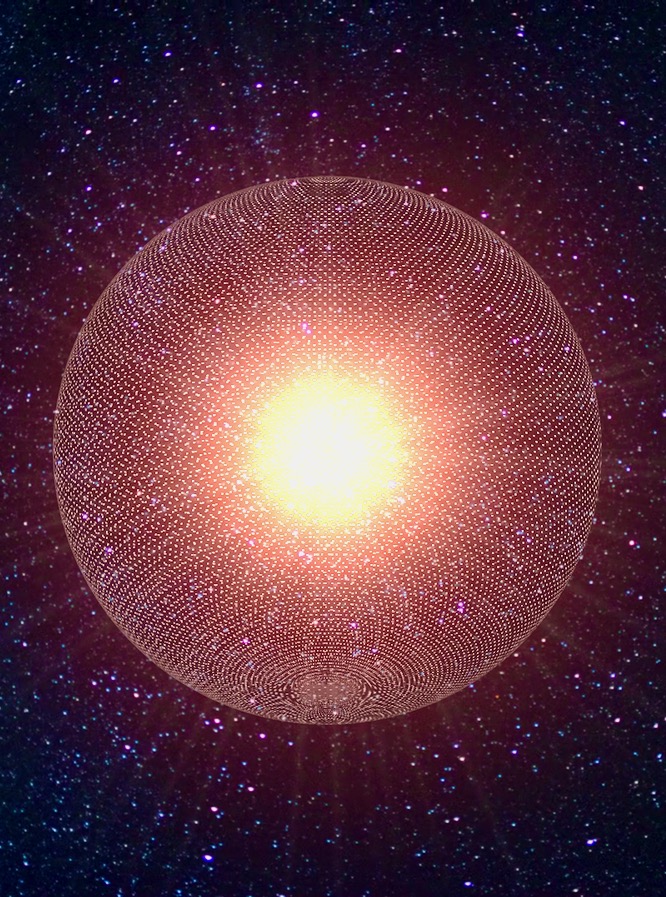

In modern usage, “sphere” usually means a **Dyson swarm**: countless independent satellites in solar orbit rather than a solid shell, which is mechanically implausible.
# What it is
Dyson’s original 1960 paper suggested that if intelligent life wanted far more energy than a planet-bound civilisation, it would arrange matter into orbiting collectors to intercept a substantial fraction of stellar light and re-radiate the energy as heat in the infrared, making the system detectable to distant telescopes - science.org
The key insight was observational: even if you don’t know how they built it, you could search for its thermal signature.
# Swarm, ring, shell
Popular imagery shows a rigid shell, but orbital mechanics and materials limits make that version unstable. Practical discussions focus on **swarms** (many satellites on coordinated orbits) or **rings** (special-case swarms) that can be assembled gradually from smaller modules. Swarms avoid crushing self-gravity and tidal issues while allowing gaps for planetary orbits and stability control - springer.com
YOUTUBE aOs7WU8Gd4c Could Aliens See Us? What Earth’s Technosphere Reveals
# Relation to Space Solar Space solar power (SBSP) takes a **single-satellite** or **constellation** approach to collect sunlight above Earth’s atmosphere and beam it down to rectennas.
A Dyson swarm is the **limit case** of the same idea: keep adding collectors until the star’s output, not Earth’s weather or day–night cycle, becomes the bottleneck. SBSP aims for gigawatts to tens of gigawatts for terrestrial grids this century; a Dyson swarm imagines **star-scale power** beyond planetary needs, placing the two on a spectrum of solar collection architectures.
# Kardashev scale and energy context
In SETI and futures studies, Dyson swarms are tied to the **Kardashev scale**, where a Type I civilisation uses the energy available on its planet, Type II uses the energy of its star, and Type III uses its galaxy. SBSP is a Type I optimisation that reduces variability and storage needs; a Dyson swarm would be the hallmark of a transition toward Type II energy budgets - wikipedia
# Thermodynamics and waste heat
Any collector network that absorbs starlight must dump low-temperature waste heat. A Dyson swarm would glow in the mid-infrared with a spectrum set by its effective temperature and coverage. Astronomers have looked for such **infrared excess** in galaxy surveys; candidates typically resolve as dust or natural astrophysics, but the method is sound and continues to improve with new instruments and sky catalogues - iop.org (pdf)
# Materials and scaling realities Even the most conservative Dyson-swarm sketches require **enormous mass, manufacturing, and control**. Order-of-magnitude exercises show that disassembling small Solar System bodies could provide the raw materials, but mining, fabrication, and orbital traffic control would dwarf any current industry. SBSP research tackles the near-term subset of these problems—thin-film photovoltaics, power beaming, robotic assembly—on manageable scales, building capabilities that are thematically related without committing to star-enclosing ambitions.
# Cultural and scientific role The Dyson sphere has become a cultural shorthand for ultra-advanced engineering, from hard sci-fi to SETI search strategies. In research, it serves as a **bounding case** for energy, megastructures, and detectability: pushing ideas to the limit reveals what is impossible, what is merely expensive, and which intermediate steps—like Rectenna fields receiving safe microwave beams—can be useful on Earth within policy and market horizons.
# Assets
dyson-sphere